Voyager FDS Emulator
The computer that's leaving the solar system. On purpose. Updated August 2026.
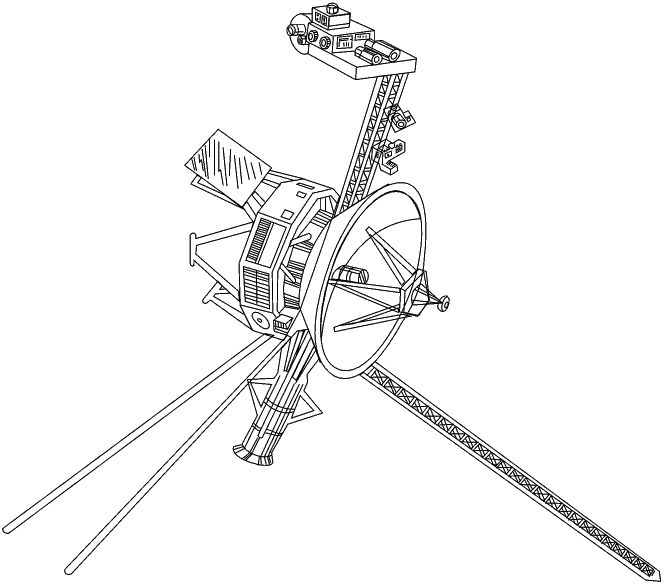
The dish has to stay pointed at us. That is the only reason any of this works.
Voyager 1 launched on 5 September 1977. Voyager 2 launched sixteen days earlier, on 20 August, because space mission naming conventions are not required to make sense. Both spacecraft are still operating. Voyager 1 is about 24 billion kilometres from Earth and has entered interstellar space. A message takes over 22 hours to reach it. The generators that power it run out sometime in the 2030s.
The Flight Data Subsystem is the computer that handles all the science data. Every photograph of Jupiter's Great Red Spot, every reading from Saturn's rings, every measurement of the heliopause, all processed by a machine running at under 1 MHz with 8,192 words of memory, which is less than the size of this web page. It has been running for 48 years without a reboot. Its last software update was in 1990.
This is the only emulator for it.
Finding the Documentation
The FDS was designed by JPL engineers in the early 1970s. The architecture memo, MJS 2.64A, is dated 7 October 1974 and was written by J. Wooddell. MJS stood for Mariner Jupiter-Saturn, which is what the programme was called before someone in public relations renamed it Voyager because that sounds better in press releases. The documentation was not updated. You work with what you have.
The problem was finding what there was to work with. These documents were not on the internet. They were not in any publicly accessible digital archive. I searched. I found nothing. I asked NASA. NASA said no. That would normally be the end of it, except I kept looking, and eventually found a blog post which referenced a Reddit comment which referenced a Hackaday article, and the Hackaday article said that the original FDS documentation had been located in the Special Collections department at Wichita State University Libraries in Kansas. Special Collections was under renovation at the time, and the renovations did not finish until the middle of 2025.
So I waited. When the renovations were done I emailed the university, explained what I was trying to do, and Brent Adams and the Special Collections team found the materials and made them available. A stranger in New Zealand, chasing a chain of links from a blog to Reddit to Hackaday to a filing cabinet in Kansas, asking about fifty-year-old spacecraft documentation, and the librarians said yes and went looking. The archives were not expecting anyone to come asking after half a century, but the people who look after them took it seriously.
The Architecture
The FDS uses an 806.4 kHz clock, because apparently that was the correct frequency for leaving the solar system. The memory is 8,192 sixteen-bit words of CMOS RAM, organised into two 4K banks. There are 36 instructions, no multiply (you use repeated addition, like it is 1974, which when this was designed it was), 128 special registers because two working registers were not enough, four DMA channels for telemetry and imaging, and a 2.5 millisecond periodic interrupt for error recovery, because space is full of cosmic rays and they are very rude about flipping bits in your memory.
The memory banking scheme deserves special mention. The FDS has 8K of memory but only 12-bit addresses, which is the sort of constraint that makes engineers either give up or get creative. JPL got creative. Four banking instructions (SETAU, SETAD, SETJU, SETJD) control whether data accesses and jumps point to the upper or lower 4K bank. Special registers always live in the lower bank because some things need to be predictable. The rest of the address space is organised chaos.
The four DMA channels handle telemetry home, the tape recorder, the cameras, and the planetary radio astronomy receiver. Priority goes telemetry first, pictures last. If you cannot tell Earth what you saw, you may as well have not seen it.
The Emulator
The emulator implements the full instruction set, the memory banking, the DMA channels, serial and parallel I/O, and the periodic interrupt handler. It includes an assembler and a disassembler, because the original engineers used punch cards and you get text files. There is an interactive debugger where you can step through instructions one at a time, dump the CPU state, and inspect memory, which is more debugging capability than the original engineers had when they were pointing this thing at Jupiter.
It is written in C and builds with any compiler from the last forty years. If you are using something older than Voyager itself, I have questions, specifically how you got it running and whether I can see it.
Putting It on a Chip
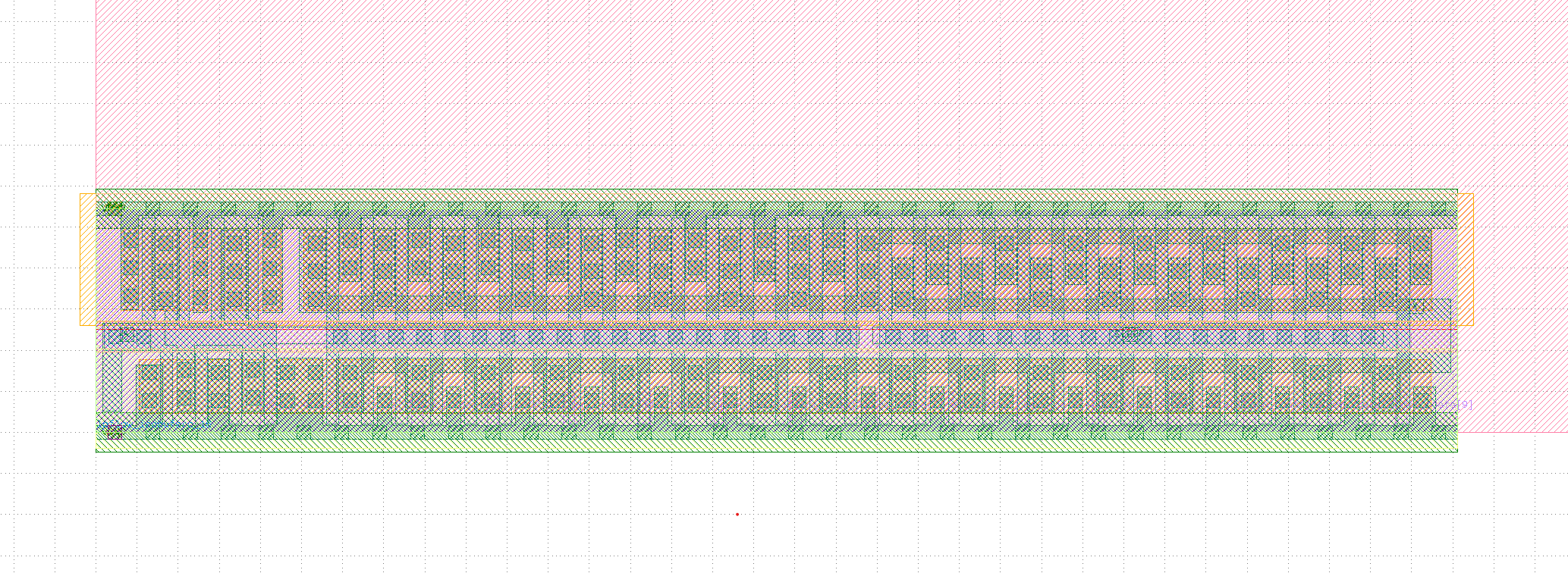
The processor on SkyWater 130nm silicon. Every coloured rectangle is a transistor. Green is polysilicon, pink is metal1, blue is nwell.
The emulator was the first step. The second, which is currently in progress, is putting the Voyager FDS on actual silicon.
The design above is a synthesisable implementation of the FDS processor, mapped to SkyWater SKY130 130nm standard cells using Takahē, an open-source hardware synthesis tool I also wrote. After optimisation the entire processor fits in 58 gates and occupies 4,793 square micrometres of silicon, which is about the width of a human hair. You could fit fifty of them on a fingernail. The original filled a shoebox.
The design meets timing at 1 MHz, which is slightly faster than the original's 806.4 kHz clock. The plan is to submit it to a SKY130 shuttle run through TinyTapeout, which costs about $150 for a tile and takes twelve to sixteen weeks to come back as fabricated silicon. I want someone to be able to hold the computer that photographed Neptune.
Acknowledgements
Thank you to Brent Adams and the Special Collections team at Wichita State University Libraries. They responded to a stranger's email asking about Voyager documentation, found the materials, and made them available. This emulator would not exist without their help.
The source documents are JPL memos MJS 2.64A (Wooddell, October 1974) and MJS77-4-2006-1A (1977), along with scanned materials from the JPL archive catalogued under MS 87-08 B37 FF41 through FF43. The instruction set is from a United States government document and is in the public domain. The implementation is original.
The source is on GitHub.
Get in Touch
Response time faster than a round-trip signal to Voyager, which is currently running at 44 hours and increasing by 61,000 kilometres per day. Has opinions about 806.4 kHz clock selection. Will explain memory banking until you ask me to stop.
If we can think this far, might not our eyes adjust to the dark?
from Relativity by Sarah Howe
Drawing of the spacecraft by Rodrigo Vieira.